The Pyramid Principle: How to Structure Any Message
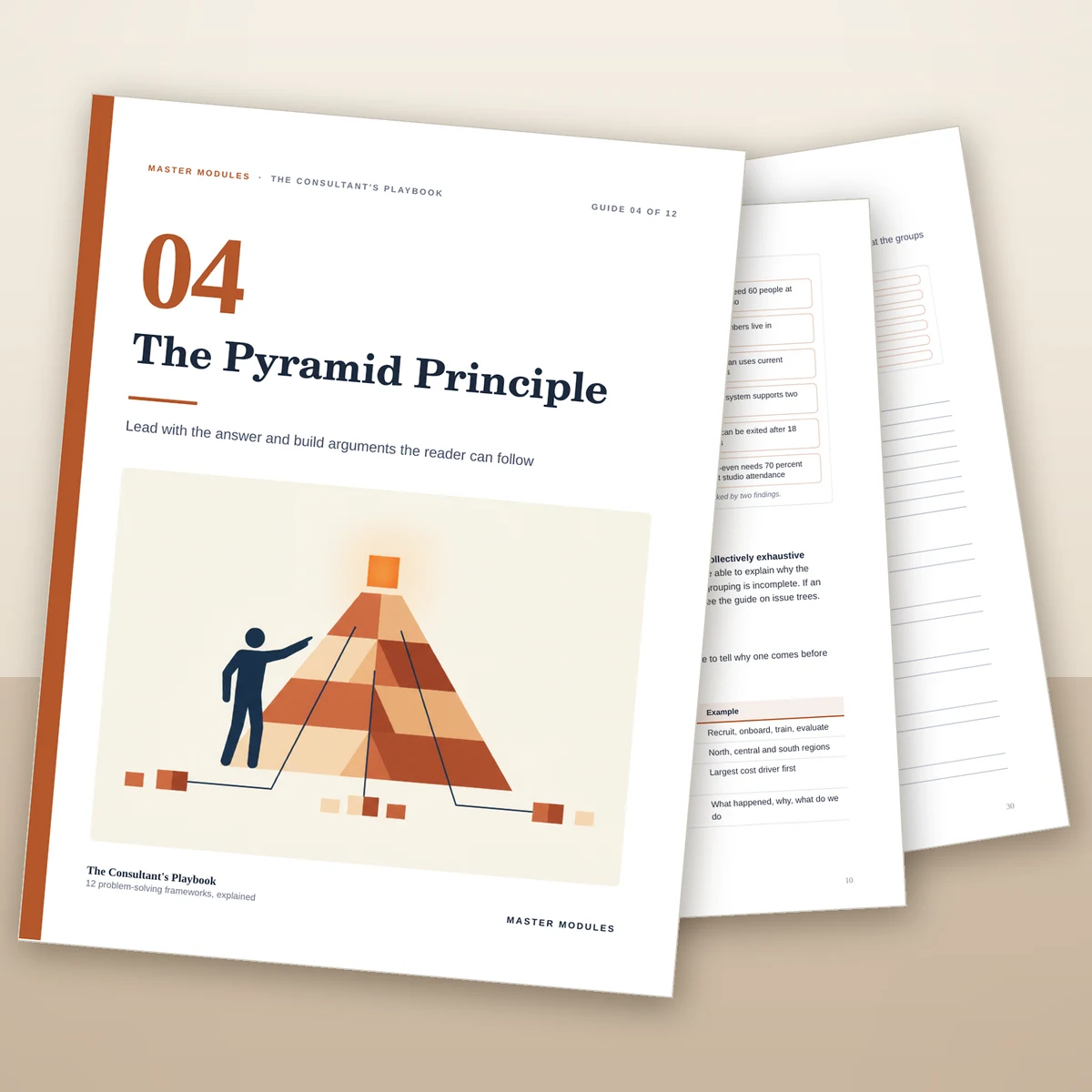
The pyramid principle is a way of structuring communication: state the answer first, then give a few grouped reasons, then the detail. A reader or listener can stop at any level and still know the main point. This page explains the tool in practical terms. It is not a substitute for the original book on the subject, which was written by Barbara Minto.
Why answer first
Most people write in the order they thought: background, analysis, findings, and finally a conclusion. The reader has to hold everything in mind until the end. Answer-first reverses it. The conclusion comes at the top, which tells the reader what to listen for, and everything that follows is read as evidence.
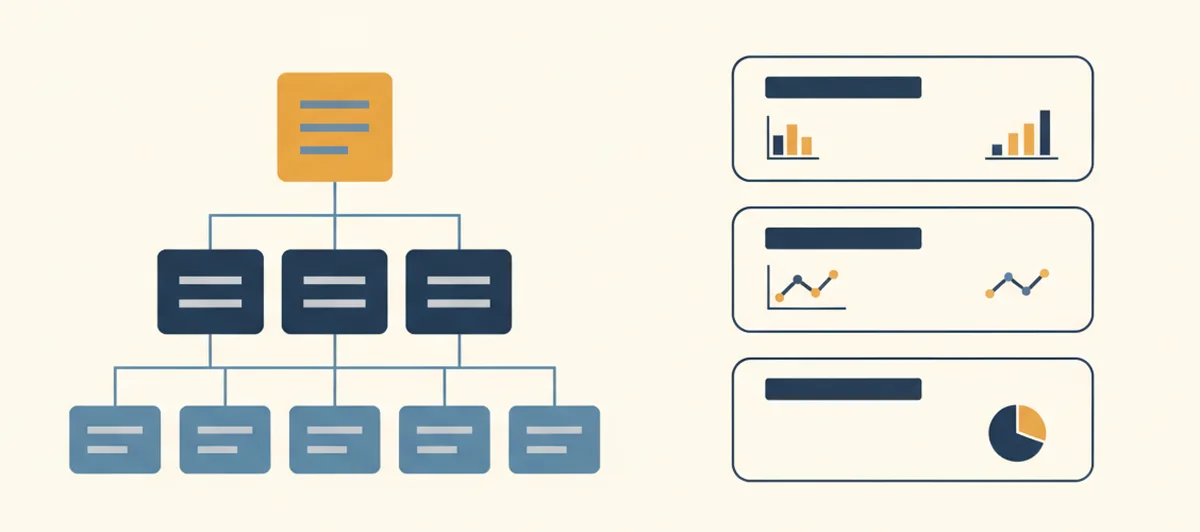
The pyramid has three levels.
| Level | What it holds | Test |
|---|---|---|
| Top | The governing thought: your answer | Does it answer the question the reader has? |
| Middle | Two to four key lines that support it | Do they together prove the top? |
| Bottom | Facts, data and examples under each key line | Does each fact support its key line? |
The introduction: SCQ (and A)
Before the answer, a short introduction makes it land. It has three parts.
| Part | Purpose | Property |
|---|---|---|
| Situation | Describes the stable context the reader already accepts | Uncontroversial |
| Complication | Introduces the change or tension that triggers a need to act | Something happened, or something is at risk |
| Question | The question the complication raises in the reader's mind | Answered by your governing thought |
Add the answer, and you have SCQA.
Example in a project email. Situation: our support team has handled all email tickets in-house since the company opened. Complication: ticket volume has doubled in a year and average first response time has grown from four hours to nineteen. Question: how should we bring response time back under eight hours? Answer: we recommend hiring two agents and adding an auto-reply that routes simple questions to help articles, starting next month.
Tips:
- Keep the situation to one or two sentences. If a reader would argue with it, it belongs in the body.
- Name the complication specifically. Replace "challenges" with the deadline, deviation or new constraint.
- Make the question the reader's, not the author's. "How did we do the analysis?" is not their question.
- Keep the introduction to about a quarter of the message at most.
Grouping and ordering ideas
Under each point, the ideas must be the same kind of thing and must be ordered logically. Three common orders:
- Time: first, second, third. Good for processes.
- Structure: by part of the whole, such as regions or functions.
- Importance: the most important first.
Check each group against MECE: no overlaps, nothing missing. An issue tree is often how you find the groups in the first place. The tree is the analysis; the pyramid is how you present the result.
Action titles
Open a weak presentation and read only the slide titles: "Market overview", "Financial summary", "Next steps". These are labels. An action title says what the slide concludes.
| Topic title | Action title |
|---|---|
| Customer satisfaction | Satisfaction fell most among customers whose first delivery was late |
| Cost breakdown | Freight and packaging explain two thirds of the rise in cost per order |
| Options | Option B reaches the goal by June at half the effort of Option A |
| Risks | Supplier concentration is the one risk that could delay launch |
Rules for a good action title:
- Write a full sentence with a subject and a verb.
- Make it specific, with the number or the named thing.
- Keep it to two lines at most.
- One message per slide.
- Prove it with the body of the slide, and remove what does not.
The title-only test: copy your slide titles into a blank document and read them as a paragraph. If they do not tell the story and answer the question, rewrite the titles before touching the slide bodies.
Storyline and ghost deck
Before building any slides, write the storyline: the answer, the key lines, and a sentence for each slide. Then sketch a ghost deck, which is a set of empty slides with only the action titles and a note on the exhibit each will use. You can test the argument with a colleague in ten minutes, before spending hours on charts.
Everyday writing
The same shape works for emails and memos.
- Subject line: carry the message or the request, with a date if there is a deadline.
- First line: the purpose or the answer.
- Second block: the two or three most important reasons.
- Detail: below, or in an attachment.
- Close: the next step, with an owner and a date.
For a longer example of summarizing a whole piece of work, see how to write an executive summary, and for a meeting format built on answer-first, see the steering committee update.
Common mistakes
- Burying the answer under history and method.
- A situation that is a history lesson. Cut it to what the reader needs to recall.
- No real complication, so there is no reason to read.
- Topic titles instead of action titles.
- A pyramid whose middle does not prove its top. Test by reading the key lines aloud with "because" between them and the top.
Test your own pyramid
- Can you state the answer in one sentence?
- Do the key lines, read together, prove it?
- Is each group MECE?
- Does each fact belong under the line where you put it?
- Does the introduction lead to exactly the question your answer addresses?
Practice it
The fourth guide in The Consultant's Playbook covers this method in seven chapters: why answer first, the SCQ introduction, grouping and ordering, action titles, storyline and ghost deck, emails and memos, and testing your pyramid. It includes a complete fictional case, and three printable worksheets: Answer-First Message Planner, Group-and-Order Worksheet, and Storyline and Ghost Deck Planner.
Educational content. It is not legal, financial or tax advice.