How to Write an Executive Summary (With a Template)
An executive summary is a one-page version of your document that lets a busy reader understand the answer and decide what to do without reading anything else. The most common failure is writing it as a table of contents in sentences: what the document covers, instead of what it concludes.
What readers want from it
A senior reader skimming a summary wants four things, in this order:
- What do you recommend, or what did you find?
- Why should I believe it?
- What does it mean for me or for the decision?
- What do you need from me, and by when?
If the summary answers those, it has done its job. Everything else belongs in the body.
The five-part structure
| Part | What goes in | Typical length |
|---|---|---|
| 1. Answer | The recommendation or main finding, in one or two sentences | 1–2 sentences |
| 2. Context | Why this matters now: situation and what changed | 2–3 sentences |
| 3. Reasons | The two to four key points that support the answer, each with its strongest fact | A short paragraph or list |
| 4. Risks and alternatives | What could go wrong, and what else you considered | 2–3 sentences |
| 5. Ask and next steps | The decision needed, who does what, and by when | 1–3 lines |
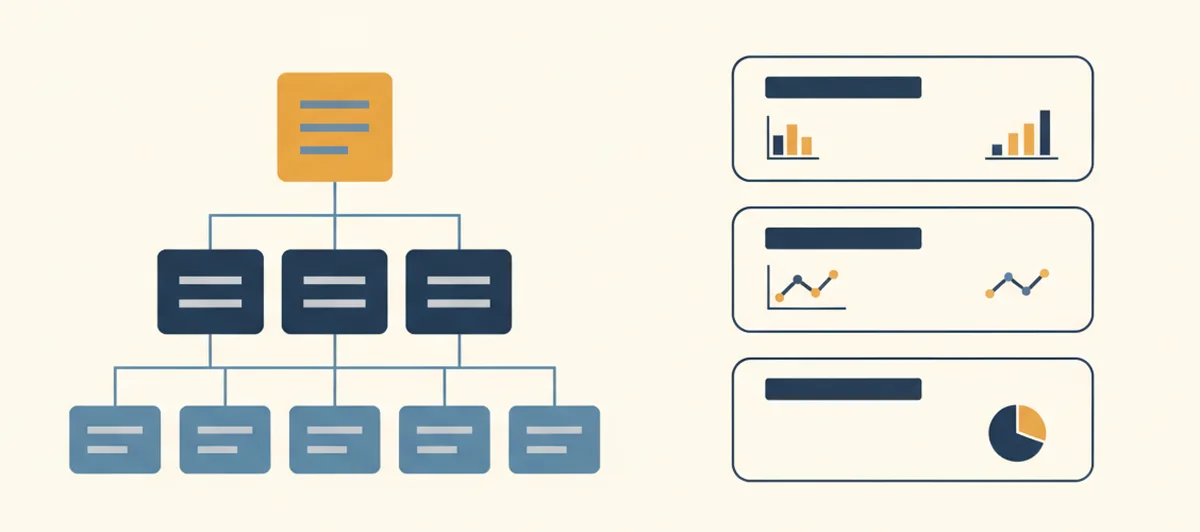
This is the pyramid principle applied to a document: answer first, grouped reasons beneath it, detail in the body.
Fill-in template
Recommendation: We recommend [action]. We ask you to approve [specific decision] by [date]. Why now: [Situation, one sentence.] However, [complication: what changed or is at risk]. This raises the question of [question]. Why this option: (1) [reason with its strongest fact]. (2) [reason]. (3) [reason]. Risks and alternatives: The main risk is [risk], which we address by [response]. We also considered [A] and [B]; we did not choose them because [reason]. Next steps: [Owner] will [action] by [date]. [Owner] will [action] by [date].
Before and after
A fictional team has finished a review of customer survey timing.
Before: "This report summarizes the work done on the customer survey. It describes the methodology, the sample and the results. Section 1 covers background. Section 2 explains the approach. Section 3 presents the findings. Section 4 gives recommendations."
This tells the reader nothing they could not get from the contents page.
After: "We recommend relaunching the customer survey in March. The sample was sound, but 70 percent of responses arrived during the holiday week, which makes them hard to compare with earlier waves. The relaunch fits in the current budget and needs two weeks of preparation. The main risk is a low response rate in March, which we can reduce with one reminder. We ask you to approve the relaunch by Thursday so that fieldwork can start on the first of the month."
The second version can be read in twenty seconds, and the reader knows what to do.
Step by step
- Write the answer in one sentence before anything else. If you cannot, you are not ready to write the summary. Go back to your problem statement and ask what the reader needed to know.
- List the two to four reasons. Check that, taken together, they prove the answer.
- Pick the single strongest fact for each reason. One number often beats three adjectives.
- State the risk honestly. A summary with no risk invites suspicion.
- End with the ask. Name the decision, the owner and the date.
- Cut. Remove background the reader already knows, method details and hedging.
- Match it to the body. Every claim in the summary must appear in the document, and every key claim in the document must show up in the summary.
Common mistakes
- Describing the document instead of summarizing it. "This report covers…" is a table of contents.
- Burying the recommendation in the last paragraph.
- Adding new information that is not in the body.
- Jargon and acronyms the senior reader may not know.
- Too long. A summary of three pages is a short report.
- No ask. If you need a decision, say what it is and by when.
Tone and wording
Write in plain, direct sentences. Use the active voice ("we recommend", not "it is recommended"), replace adjectives with numbers where you can, and define any acronym the reader might not know. Read the summary aloud once. If you stumble over a sentence, shorten it. If a sentence could be removed without changing the decision, remove it. A summary earns trust by being short, specific and consistent with the pages behind it.
Checklist before you send
- The first sentence is the answer or the ask.
- A reader who stops after one paragraph still knows what you recommend.
- There are no more than four key reasons.
- Each reason has a fact behind it.
- The risks and at least one alternative are named.
- The next step has an owner and a date.
- Nothing appears in the summary that is not in the document.
Where summaries are used
The same structure works for the opening page of a project report, the first block of a steering committee update, a decision memo and a proposal. For a project that is just starting, a project charter plays a related role: it summarizes why the work exists, what is in scope and who is accountable.
Practice with the full method
Guide 4 of The Consultant's Playbook walks through answer-first structure, the situation-complication-question introduction, grouping and ordering ideas, action titles, storyline and ghost deck, and writing for emails and memos. Guide 12 adds the decision memo and a two-page structure for senior readers. The Answer-First Message Planner worksheet gives you a blank frame for your own summary.
Educational content. It is not legal, financial or tax advice.