Issue Tree: How to Build One Step by Step
An issue tree breaks one big question into smaller questions, level by level, so that each end point can be answered with a piece of data or a short analysis. It is also called a logic tree. Its leaves become your workplan.
The rule that holds a tree together is MECE: at every split, the branches must not overlap and must cover the whole of the parent.
Anatomy of an issue tree
- Root: the key question, ideally written to meet the tests in problem statement examples.
- Branches: a MECE division of the question.
- Sub-branches: a further division of each branch.
- Leaves: questions concrete enough to answer with data, a calculation or a conversation.
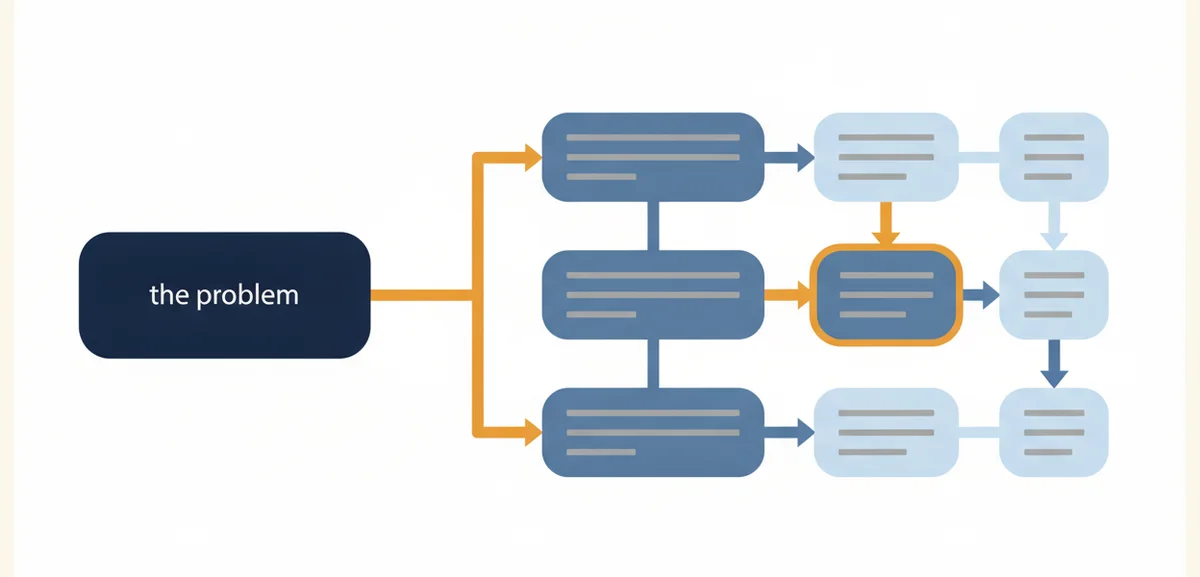
A simple example with a fictional membership club. Root: "Why did members at year end fall?" Because members at year end equal starting members plus joiners minus leavers, the first split is fewer joiners, more leavers, or a change in how members are counted. That is complete by arithmetic. Each branch can then be split again, for example leavers by stated reason.
The three types of tree
| Type | Root question | Branches are | Typical use |
|---|---|---|---|
| Why-tree (diagnostic) | Why did X happen? | Possible causes | Explaining a drop, delay or defect |
| How-tree (solution) | How can we achieve X? | Possible actions | Generating and organizing solutions |
| Hypothesis tree | Is X true? Should we do X? | Conditions that must hold for X | Testing an answer you already suspect |
A common sequence is to build a why-tree to find the causes, pick the biggest one, then build a how-tree under it to find ways to act.
Seven rules for building a tree
- Write the root as a question that is specific enough to be answered.
- Use one way of dividing at each level, and use it for all siblings.
- Keep three or four branches per node. Group if you have eight.
- Make branches parallel in form, all nouns or all short statements.
- Go down evenly until leaves can be tested. Do not over-split branches that are already answerable.
- Check MECE at each split by asking what overlaps and what is missing.
- Label unknowns honestly. Mark branches that are guesses and those backed by data.
The second rule trips up more people than any other. If you divide customers by region in one branch and by product in another, a northern customer who buys product A fits both.
Driver tree example
A driver tree is an issue tree built on a formula. It is the most reliable way to move from a vague worry to concrete data, because every branch is a number you can measure.
For a retailer, revenue equals visitors times conversion rate times average basket. If revenue fell 10 percent, you check which of the three factors moved. Suppose visitors held steady and conversion dropped. Go one level down: did fewer people add to cart, or did more abandon at checkout? Two or three lookups can locate a problem that a week of speculation would not.
For costs, divide first by behavior.
| Level 1 | Level 2 | Example items | Typical question |
|---|---|---|---|
| Variable cost | Ingredients | Flour, butter, eggs | Did input prices or waste change? |
| Variable cost | Packaging and fees | Boxes, card fees | Did order mix or fee rates change? |
| Fixed cost | Premises | Rent, utilities | Is space matched to sales? |
| Fixed cost | Staff | Salaried managers, base hours | Is the schedule matched to demand? |
For operations, the natural tree follows the process steps. Total time equals the sum of the time at each stage, so measure each stage and look for the one that contributes most.
Choose the formula for which you have data, which your audience understands and which separates what you can influence from what you cannot.
Hypothesis tree example
When time is short and you already have a view, put it at the root and ask what would have to be true.
Root: "We should open a second clinic." Conditions: there is enough demand in the new area, the economics work, and we can staff it. If all three hold, the claim holds. If any fails, it fails. This gives you a stopping rule: if the demand branch fails, you do not need to polish the economics. Test the weakest or cheapest condition first.
Issue tree template
You can copy this structure into any document or whiteboard.
- Key question: [one question with a time frame]
- Dimension used at level 1: [formula / process / segment / time / internal-external / yes-no]
- Branches (3 or 4): [A], [B], [C]
- For each branch, dimension used at level 2: [ ]
- Leaves: [question] — Data needed: [ ] — Owner: [ ] — Status: supported / ruled out / unknown
Using the tree
- Prune as you learn. Mark each branch supported, ruled out or unknown. A tree that grows without pruning becomes a wall chart nobody reads.
- Turn leaves into a workplan. Each leaf needs data, an owner and a date.
- Prioritize. Start with leaves that are cheap to test or that could end a whole branch.
- Communicate. The pruned tree tells the story: here is what we considered, what we eliminated and why, and what remains.
Common mistakes
- The brainstorm trap. A whiteboard of ideas is a list, not a tree.
- Mixed dimensions. Fix by choosing one dimension per level.
- Too deep, too early. Split only until a leaf can be tested.
- No pruning. Evidence should change the picture.
- Ignoring dependence. If two drivers move together by nature, such as price and volume in a discount, combine them into one branch.
From tree to message
Once the tree has told you where the answer is, you still need to communicate it. The pyramid principle guide covers how to turn findings into an answer-first message, and back of the envelope calculation shows how to size branches quickly before you commit to deeper analysis.
Go deeper
Guide 2 of The Consultant's Playbook gives issue trees a full treatment: structure and types, driver trees for revenue, costs and processes, hypothesis trees and how-trees, how to test a tree where MECE breaks, and how to use the tree for workplan, priorities and communication. It includes a worked case, an Issue Tree Builder and a Driver Tree and Workplan worksheet.
Educational content. It is not legal, financial or tax advice.