The MECE Framework: What It Is and How to Apply It
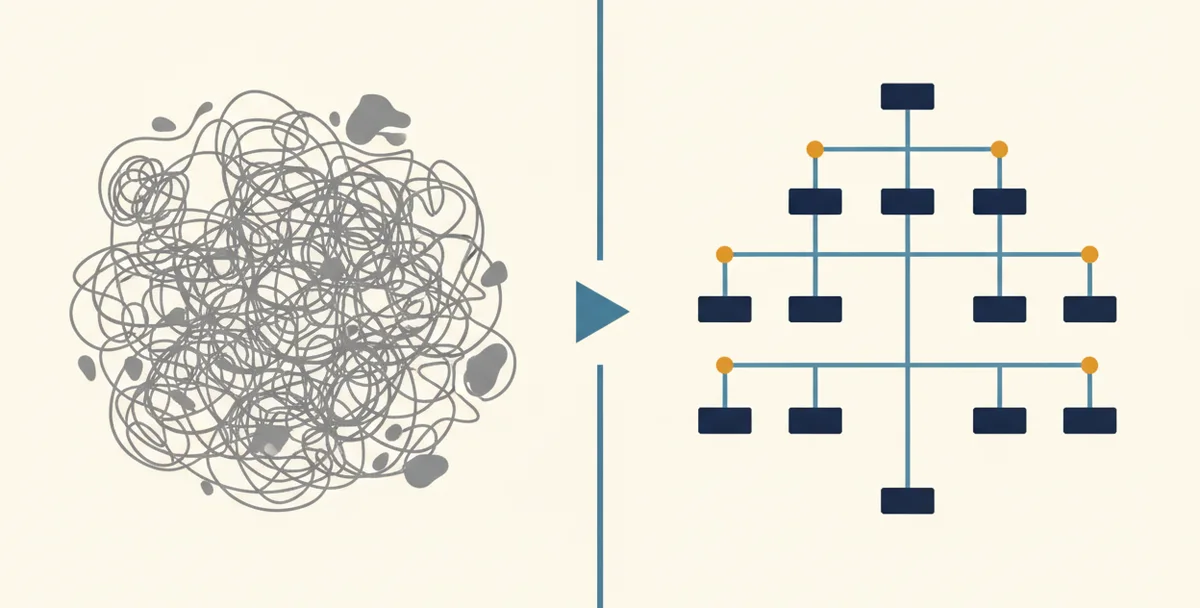
MECE stands for mutually exclusive, collectively exhaustive: a way of splitting a problem into parts so that nothing overlaps and nothing is missing. It is pronounced "mee-see". It is the rule behind every good issue tree, and you can apply it in seconds to any list.
The phrase is associated with Barbara Minto, who taught the idea in consulting in the 1960s and 70s, and it has since become shared vocabulary for structured thinking.
The two halves of MECE
| Half | Plain meaning | What breaks it | What it costs you |
|---|---|---|---|
| Mutually exclusive | Each item belongs in exactly one bucket | Categories that share members, such as "online" and "mobile" sales | Double counting, repeated work, muddled arguments |
| Collectively exhaustive | Together the buckets cover everything | A missing category, such as forgetting returns when listing costs | A blind spot where the real answer may hide |
Think of a pie. A MECE split cuts the whole pie into slices. If the slices overlap, you count some of the pie twice. If they leave a hole, part of the pie is missing from your plan. When the slices fit exactly, you can work on each separately and know that adding them up gives you the whole.
Why it matters in practice
- It prevents blind spots. If your branches are exhaustive, the answer must be somewhere in the tree.
- It prevents double counting. Mutually exclusive categories add up correctly.
- It lets you divide the work. Two people can take separate branches without duplicating each other.
- It makes your argument credible. A reader who sees a clean split trusts that you looked at everything, and can challenge one branch instead of the whole.
MECE examples: bad split, better split
Suppose a manager at a fictional gym chain wants to understand why membership fell, and lists these reasons: price too high, poor service, competitors, bad location, equipment problems, seasonality.
Test it with two questions.
- Overlap check: could one thing belong to two of these? Yes. A cheaper competitor is both "price" and "competitors". Broken machines could be "service" or "equipment".
- Gap check: what would not fit in any of these? Members who left for reasons unrelated to the gym, such as moving away.
A cleaner split starts from arithmetic: membership at year end equals starting members plus members who joined minus members who left. So the possible causes of a fall are fewer joiners, more leavers, or a change in how members are counted. That list is complete by construction, and each branch can then be split again, for example leavers by reason.
The best MECE splits are often backed by a formula or an obvious whole.
Common ways to divide a problem
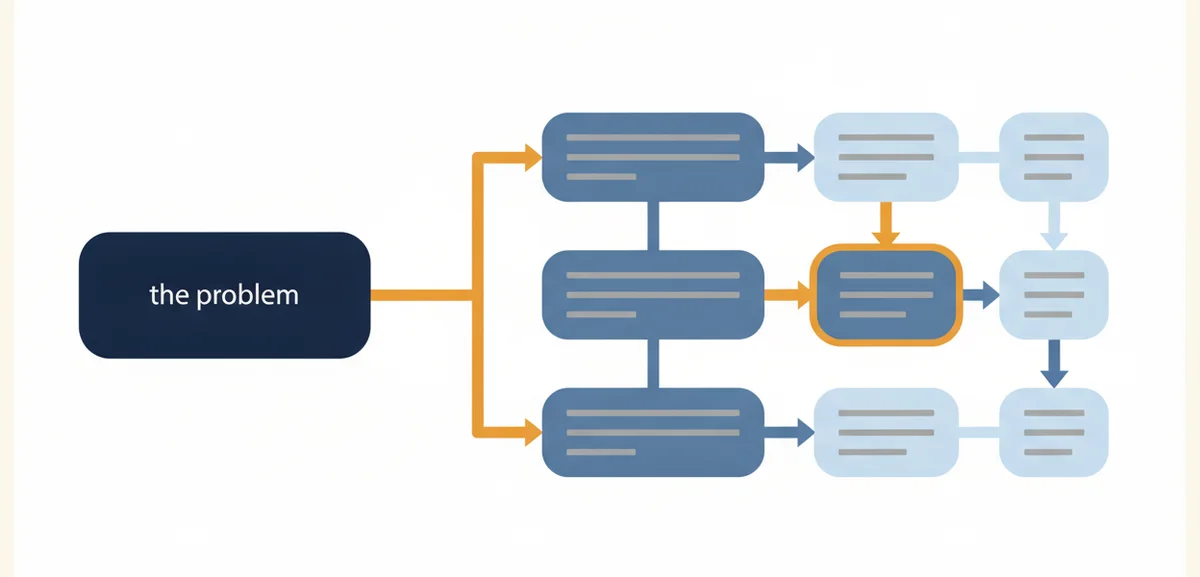
You rarely need to invent a split from scratch. A handful of dimensions cover most business questions.
| Dimension | Example |
|---|---|
| Formula | Profit = revenue minus cost; revenue = volume × price |
| Process steps | Awareness, trial, purchase, repeat purchase |
| Segments | Customer type, region, product, channel |
| Time | Before and after a change, or by period |
| Internal and external | Factors inside our control and those outside it |
| Yes and no | Customers who return and customers who do not |
Try each in turn until one gives a clean, useful split. Different dimensions produce different trees for the same question, and none is wrong. The best one points fastest at where the answer lies and matches data you can actually get.
One dimension per level
The mistake that trips up most people is mixing dimensions at the same level. "Revenue drop: north region, south region, product A" mixes geography with product. A customer in the north who buys product A fits two buckets. Divide by one dimension at each level, for example first by region and then, inside each region, by product.
Two quick tests you can run aloud
- "Could one thing belong to two of these?" If yes, there is overlap.
- "What would not fit in any of these?" If you can name something, there is a gap.
These take seconds and catch most errors. Ask the second question as if you were a skeptic in the room: what would they say you forgot?
MECE is a goal, not a law
In real work, causes interact and categories blur. The right attitude is to aim for MECE, notice where you fall short and say so. A small overlap, labeled as such, is acceptable. An unlabeled gap is not. If you add an "other" bucket to make a split exhaustive, check its size. If it holds a large share of the whole, your split is not doing its job.
Where MECE shows up
- Issue trees. Every level of a tree should be MECE with respect to its parent. See the issue tree guide.
- Problem definition. A clear scope is itself a MECE cut of what is in and what is out. See problem statement examples.
- Presentations and writing. Points grouped under one idea should be parallel and complete. See the pyramid principle guide.
- Estimates. A bottom-up decomposition only adds up if its parts are MECE. See back of the envelope calculation.
A short exercise
Take any list you have used recently, such as reasons customers cancel, risks on a project or categories in a budget. Write it down and run both tests. Then rewrite it starting from a formula, a process or a clear whole, and compare the two versions. Most people find one overlap and one gap in the first pass.
Practice it properly
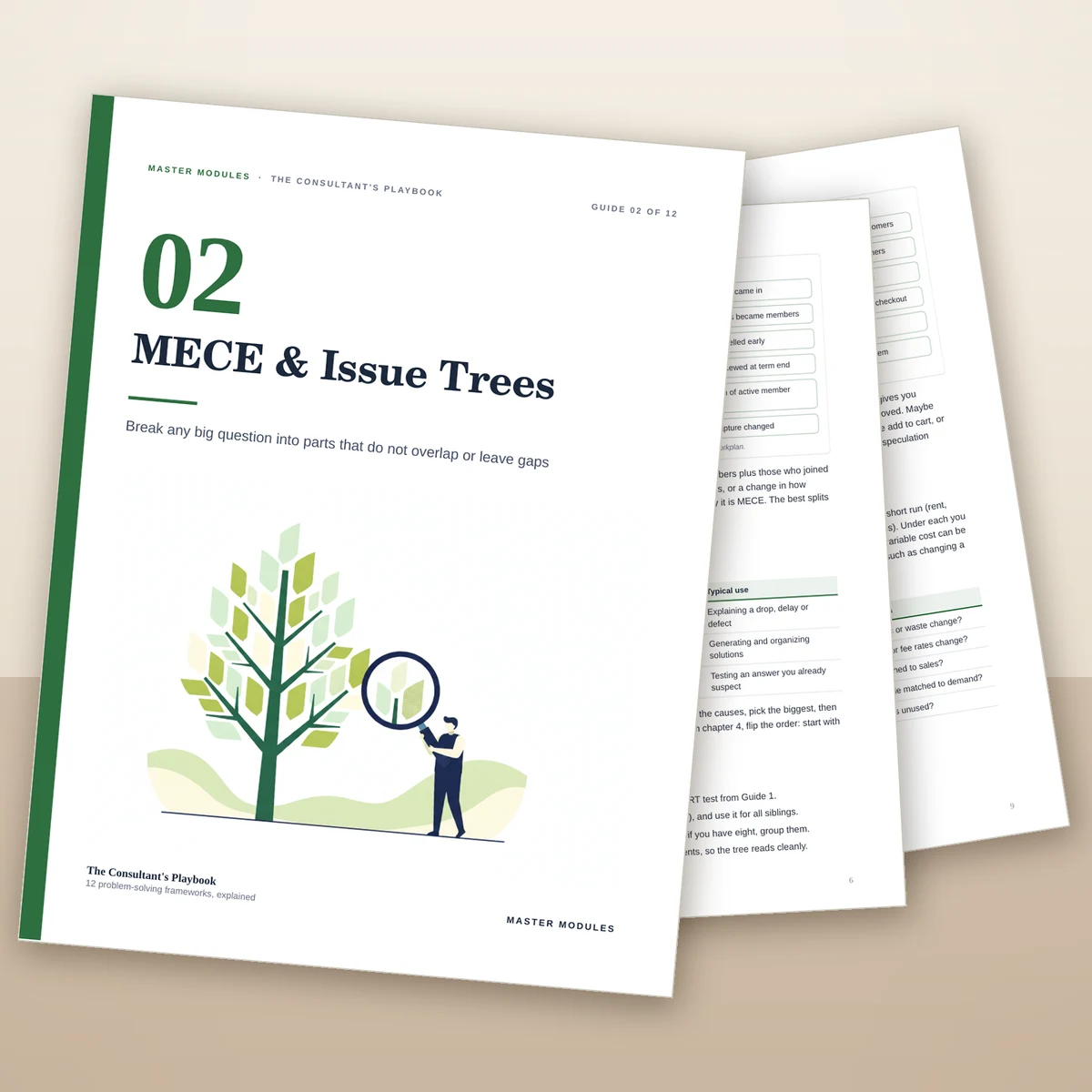
The second guide in The Consultant's Playbook teaches MECE and issue trees together. It covers why overlaps and gaps happen, how to test a tree where MECE breaks, how to use the tree to plan analysis and priorities, and a complete fictional case from question to recommendation. It includes a MECE Test Sheet and an Issue Tree Builder you can print and fill in, and the Consulting Glossary bonus defines the vocabulary used throughout.
Educational content. It is not legal, financial or tax advice.