TOWS Matrix: Turn Your SWOT Into Strategic Options
A TOWS matrix crosses the internal factors in a SWOT (strengths and weaknesses) with the external ones (opportunities and threats) to generate concrete strategic options. A finished SWOT is a list. TOWS turns it into a set of moves you can debate and choose between.
The method was developed by the strategy scholar Heinz Weihrich in the early 1980s. The name is simply SWOT spelled with the external factors first.
Why SWOT is not enough
The weakness of a plain SWOT is that its four boxes sit side by side and never interact. Teams finish the exercise with a tidy grid and no decisions. TOWS adds the missing step: ask what you could do by combining one item from one box with one item from another.
The four quadrants
| Opportunities (O) | Threats (T) | |
|---|---|---|
| Strengths (S) | SO: use strengths to take advantage of opportunities | ST: use strengths to reduce the impact of threats |
| Weaknesses (W) | WO: overcome weaknesses by taking advantage of opportunities | WT: minimize weaknesses and avoid threats |
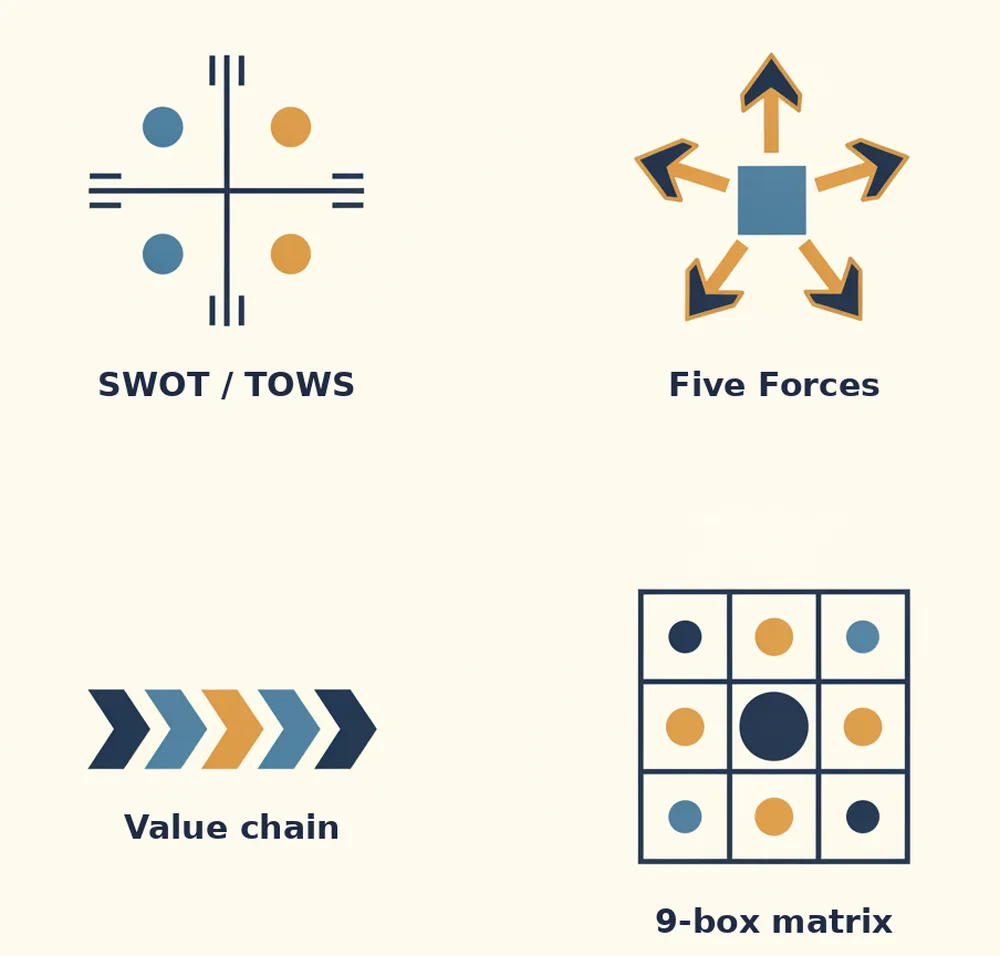
Each quadrant has a different attitude.
- SO options are the comfortable growth ideas. The risk is complacency, because every company can invent them.
- WO options are about investment. They usually show where the real bottleneck sits.
- ST options protect an existing position. Good ones turn a threat into a reason customers prefer you.
- WT options are the uncomfortable ones: defensive moves, exits or fixes. Be honest about this quadrant.
How to build the matrix
- Finish a good SWOT first. Back each item with evidence. Vague items give vague options.
- Take the top three to five items from each box. Give them short codes: S1, S2, W1, O1, T1.
- For the SO quadrant, pair each strength with each opportunity and write the move that results, citing the codes (for example S1+O2).
- Repeat for WO, ST and WT. The technique is mechanical on purpose. Pairing every item prevents you from stopping at the first idea.
- Delete moves that are vague, impossible or duplicates.
- Group similar moves into three to six strategic options and give each a short name.
- Rank the options against your decision criteria.
TOWS analysis example
A fictional furniture maker, Cedar Row Furniture, has these top items.
- S1: fast workshop lead time. S2: solid-wood craftsmanship.
- W1: no digital marketing skill. W2: small production space.
- O1: rising demand for made-to-order pieces online.
- T1: retailers offering assembly with delivery. T2: volatile lumber prices.
| Pairing | Strategic move |
|---|---|
| S1 + O1 | Launch a made-to-order online store promising delivery in two weeks. |
| W1 + O1 | Hire a part-time e-commerce specialist or partner with an agency before launch. |
| S2 + T1 | Position on durability and offer paid assembly from our own team. |
| W2 + T2 | Fix the price list quarterly and cap online volume to workshop capacity. |
Grouped into named options:
- Online made-to-order: S1+O1, with W1+O1 as its enabling step.
- Defend the showroom: S2+T1.
- Protect margin: W2+T2.
Naming matters. Teams remember and debate "Online made-to-order" far better than "SO-3", and a name forces you to say what the option actually is.
Checks before you rank
- Coherence: can options be combined, or do they compete for the same people and budget?
- Feasibility: does an option require capabilities you only wish you had?
- Reversibility: can you test it cheaply, or is it a one-way door?
- Fit with the decision: does it answer the original question or drift into another one?
The output of TOWS should be a short list of options, each written as an action of a size one owner could take on. "Be more digital" is not an option. "Launch a made-to-order store with ten products in the next six months" is. If an idea cannot be written that way, return to the pairing and ask what specific step it would require.
Common mistakes
- A SWOT full of generic items such as "good team" or "competition". These produce generic options.
- Skipping the evidence. Strengths that customers do not notice are not strengths.
- Stopping at the first pairing that feels right.
- Ignoring the WT quadrant because it is unpleasant.
- Too many options. Group them, and name them.
- No link to the decision. Start from the question you need to answer. A problem statement keeps the analysis focused.
What to say in the room
- "We have a long SWOT. Let us see which strengths line up with which outside openings."
- "This option is in WO: it only works if we fix the weakness first, so the cost of fixing it belongs in the case."
- "Two of our biggest threats meet our two biggest weaknesses. We should be honest about the WT quadrant."
- "Can we write that idea as a specific action someone could start next month?"
Where TOWS fits
TOWS is one tool in a larger set. Use it to generate options, then test whether a resource-based advantage lasts with VRIO. To make sure the lists you start from are complete and do not overlap, check them against the issue tree guide. To present the results, use an answer-first structure from the pyramid principle guide.
Go deeper
Guide 5 of The Consultant's Playbook shows how to run SWOT that says something, move from SWOT to TOWS, read the macro environment with PESTLE, assess industry profit with Five Forces, combine the tools into one readout and write a one-page strategic summary. It includes a fictional packaging company case and a worksheet called SWOT with Evidence and TOWS Pairings, plus a Five Forces rating sheet.
Educational content. It is not legal, financial or tax advice.