Project Charter Template: What to Include
A project charter is a one-page agreement on why a project exists, what it will deliver and who is in charge. The sponsor signs it before work starts. It is the document you return to when someone asks "wasn't this meant to include…?" and the one a new team member reads first.
The nine sections of a charter
| # | Section | What it answers |
|---|---|---|
| 1 | Project summary | Name, sponsor, lead, dates and version |
| 2 | Problem or opportunity | What is wrong or possible, who is affected, why now |
| 3 | Objectives and success measures | What will be different, how we will know |
| 4 | Scope | What is in and what is explicitly out |
| 5 | Deliverables and milestones | What will be produced and by when |
| 6 | Team and stakeholders | Who is involved and how |
| 7 | Governance | Which meetings, how often, who attends |
| 8 | Assumptions, risks and constraints | What we are relying on and what could go wrong |
| 9 | Approval | Who signs and when |
Write each section well
1. Project summary
A small table: project name, sponsor (name and title), project lead, start date and target end date, version and date. Keep it to five lines.
2. Problem or opportunity
Two to four sentences: the problem, who is affected and why it matters now. If you have already written a problem statement, reuse it here.
3. Objectives and success measures
Use a table with the objective, measure, baseline, target and date. Make each objective specific, measurable, achievable, relevant and time-bound.
| Objective | Measure | Baseline | Target | Date |
|---|---|---|---|---|
| Shorten refund handling | Days from request to refund | 9 | 5 | End of Q3 |
| Reduce escalations | Share of refunds escalated | 8% | 3% | End of Q3 |
4. Scope
Two columns: in scope and out of scope. The out-of-scope column is the one that prevents arguments. Name at least two items.
| In scope | Out of scope |
|---|---|
| Standard consumer refunds | Business accounts |
| The refund approval step | Changes to the returns policy |
5. Deliverables and milestones
List what you will produce, an owner for each and a target date. Include the kick-off and the closure so the project has a visible start and end.
6. Team and stakeholders
Name the sponsor, the lead and the main stakeholders, with their involvement and level of interest and influence. For a clear view of who does what, a RACI matrix pairs well with this section.
7. Governance
A short table of forums: the team stand-up, a weekly status, a steering meeting at each milestone. Include frequency, participants and purpose.
8. Assumptions, risks and constraints
List the three to five things you are relying on, for example data access or availability of a specific person, and the top risks with an owner for each.
9. Approval
A line for the sponsor's name and date. A sponsor who signs is a sponsor who has read it.
Charter versus scope statement versus SOW
These documents overlap, so it helps to separate them.
| Document | Main purpose | Audience |
|---|---|---|
| Problem statement | Defines the question and what a good answer looks like | The team and the decision owner |
| Project charter | Authorizes the project and records who runs it | Sponsor, team and stakeholders |
| Scope statement | One page that fixes the boundaries of the work | Sponsor and team |
| Statement of work | Specifies deliverables, acceptance and commercial terms | Client and supplier |
For small projects, one page that combines the charter and the scope statement is usually enough.
Tips for a charter people actually use
- Keep it to one page. If it runs long, you are writing a plan.
- Use numbers. Baselines and targets turn a hope into a goal.
- Get the sponsor to sign. A charter nobody signed is a suggestion.
- Write out of scope first. It forces the hard conversation early.
- Update it deliberately. Change the version number when you change the content.
- Link it to the process. For improvement projects, scoping with a SIPOC diagram fills most of sections 2, 4 and 6.
A short example in full
A fictional online retailer wants to shorten refund handling. The charter fits on one page.
- Summary: Refund Speed Project; sponsor: head of customer operations; lead: operations analyst; eight weeks; version 1.0.
- Problem: Refunds take nine days on average, and customers contact support about their status. Escalations take agents' time.
- Objectives: Cut the average from nine days to five, and cut escalations from 8 percent to 3 percent, by the end of the quarter.
- Scope: Standard consumer refunds, from request to money returned. Out: business accounts, returns policy changes.
- Deliverables: Process map, root-cause findings, revised approval step, new status message, handover pack.
- Team: Analyst, two agents, one finance contact, one person from the warehouse team.
- Governance: Weekly status note, a steering meeting at the end of diagnosis and at the final recommendation.
- Assumptions and risks: Order data available in week one; finance approval times may be the real bottleneck.
- Approval: Sponsor signs and dates.
Notice how short each line is. A charter works because everyone can read it in two minutes.
Common mistakes
- Objectives without measures.
- A scope with no "out" list.
- A sponsor in name only, who does not remove obstacles.
- A team list with no roles.
- Milestones that are activities ("start work") instead of deliverables.
- A charter written after the work has begun.
Printable and editable versions
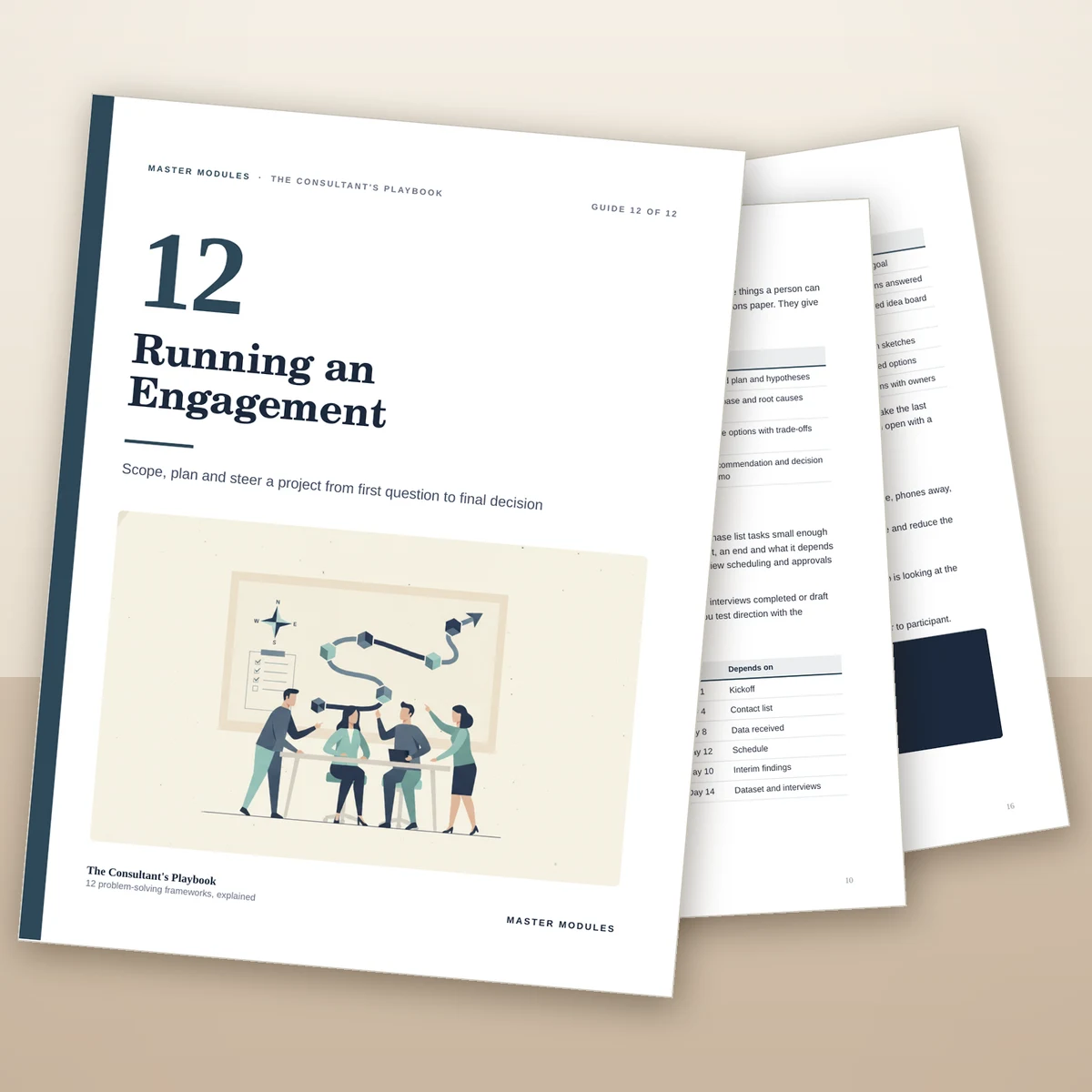
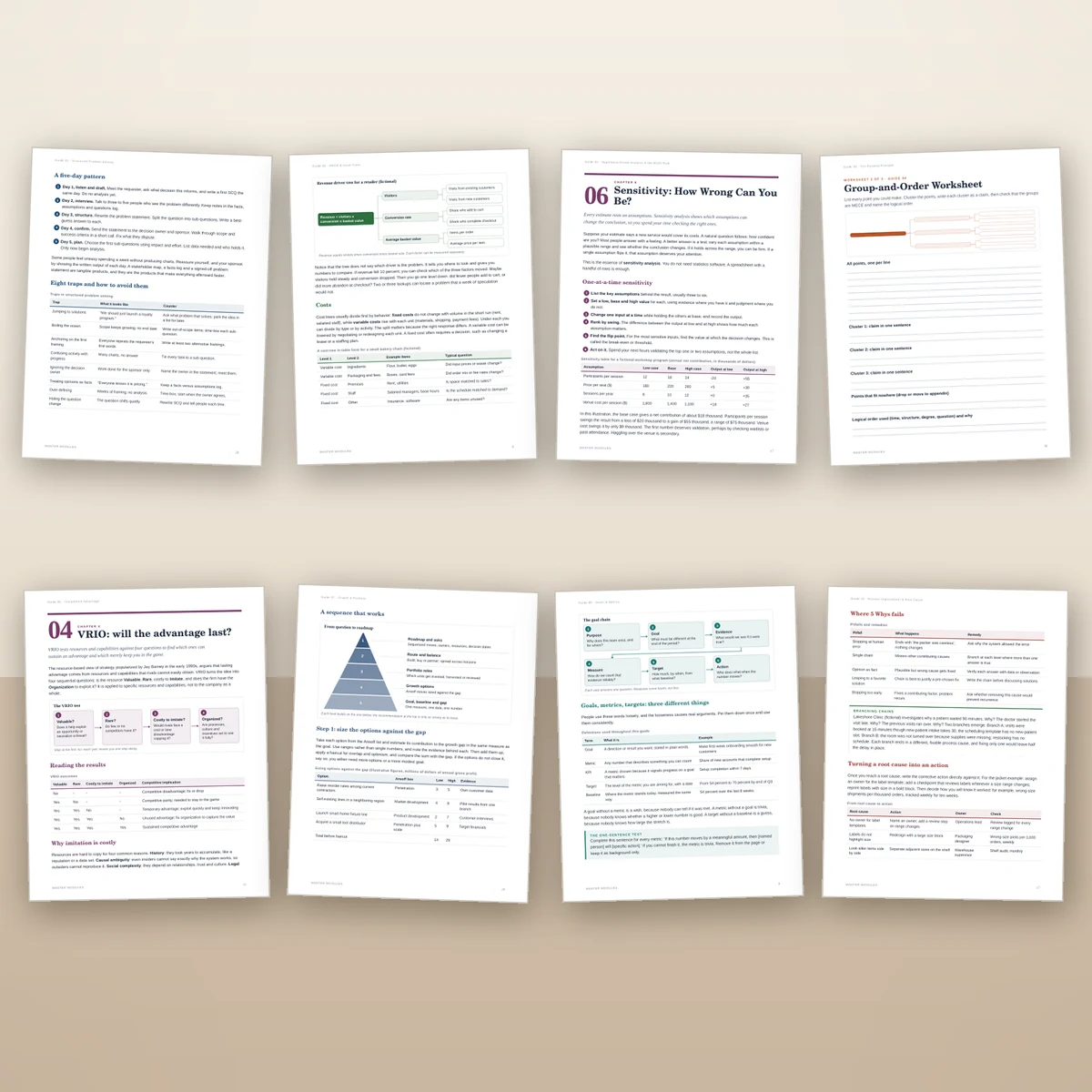
In The Consultant's Playbook, the project charter appears in two places. Guide 10 includes the Project Charter and SIPOC worksheet, a printable frame for an improvement project. Guide 12 includes a Scope Statement worksheet, a Workplan and Risk Log, and an Interview Guide and Workshop Design sheet for running an engagement. Editable templates are a separate add-on and are not part of the base playbook.
Educational content. It is not legal, financial or tax advice.