RACI Matrix Template and Example
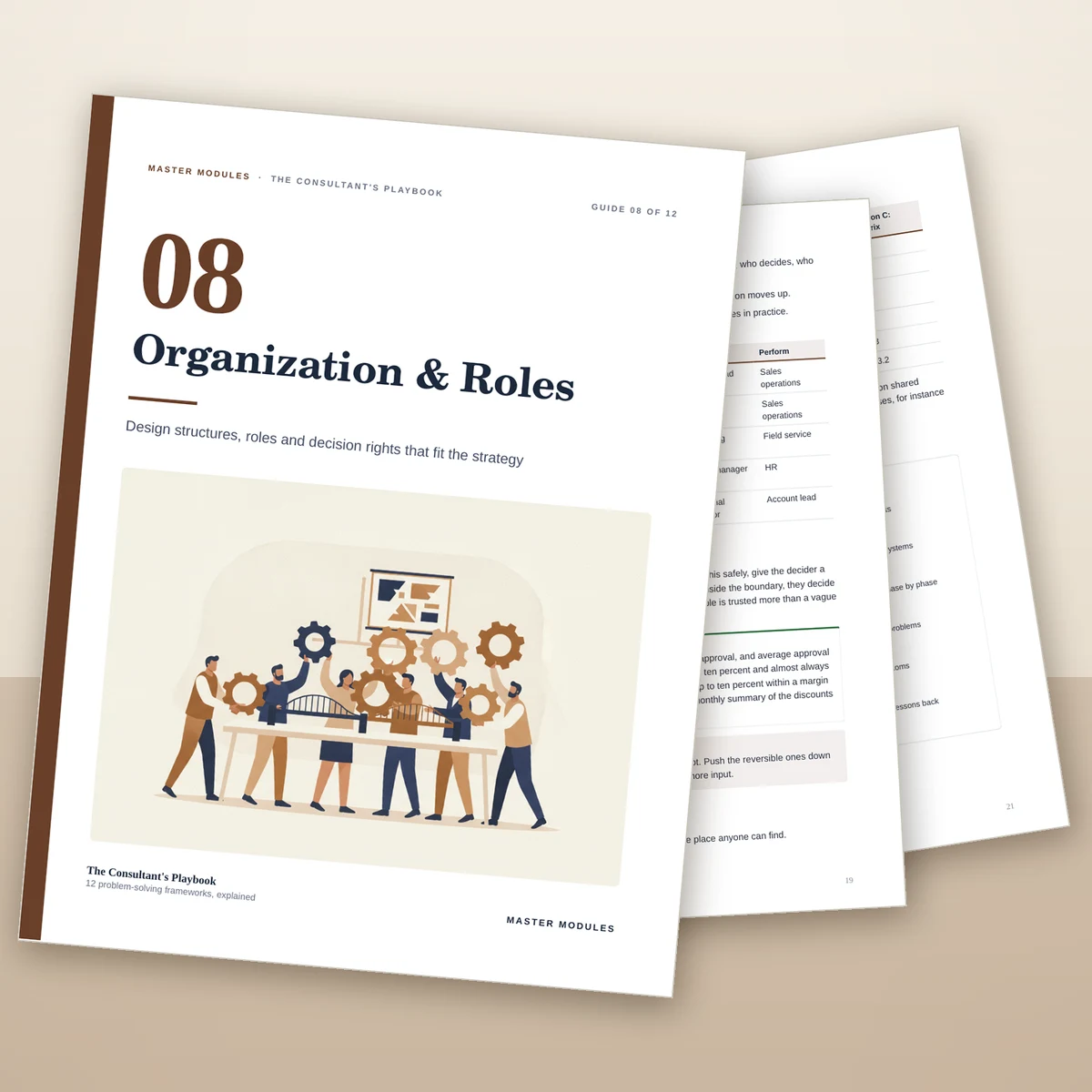
A RACI matrix is a chart that shows, for each task or decision, who is Responsible, Accountable, Consulted and Informed. It is a staple of project and operations management because it forces a short conversation that most teams skip: who is accountable for this?
The four letters
| Letter | Meaning | Rule of thumb |
|---|---|---|
| R: Responsible | Does the work | Can be several people |
| A: Accountable | Owns the outcome and signs off; answerable if it goes wrong | Exactly one per task |
| C: Consulted | Gives input before the work or decision is finalized; two-way communication | Keep the list short |
| I: Informed | Told about progress or results; one-way communication | Only those who need to know |
Two rules make a RACI work:
- Every task needs exactly one A. Two accountable people mean nobody is.
- Every task needs at least one R. If nobody does the work, the chart describes a wish.
The same person can be both A and R when the work is small.
RACI matrix example
A fictional equipment-service company maps the steps of quoting a customer. Roles are across the top, tasks down the side.
| Task | Sales rep | Service engineer | Account lead | Finance | Customer success |
|---|---|---|---|---|---|
| Qualify the request | R | C | A | I | I |
| Inspect the site | I | R | A | C | |
| Prepare the quote | R | C | A | C | |
| Approve pricing | C | R | A | ||
| Send the quote | R | A | I | I | |
| Follow up after 7 days | R | A | I |
Read across a row to see who is involved in a task, and down a column to see a role's load. Here, the account lead is Accountable for most rows, which may be reasonable or may signal a bottleneck, and finance is Accountable only for pricing approval.
Blank RACI template
| Task or decision | Role 1 | Role 2 | Role 3 | Role 4 | Role 5 |
|---|---|---|---|---|---|
Validation checklist
- Each row has exactly one A.
- Each row has at least one R.
- No role is overloaded with As.
- No row has more than two or three Cs.
- Every I has a reason to be informed.
How to build one
- List the tasks or decisions at the level where handoffs happen. Ten to twenty rows are usually enough.
- List the roles across the top. Use roles, not names, since people change.
- Fill in the letters from the real situation, not the intended one.
- Check each row for exactly one A and at least one R.
- Check each column. A role with too many As is overloaded. A role with many Cs may be a bottleneck.
- Review the result with the people in it, then agree on the target version.
Reading the chart for problems
| What you see | What it means | Fix |
|---|---|---|
| A row with no A | No one is accountable | Decide who, and give that person the authority |
| A row with two As | Accountability is shared, so it is nobody's | Choose one |
| A row with no R | The work is not assigned | Name who actually does it |
| A role with Rs everywhere and no As | Doers without authority, escalating every decision | Move some accountability down |
| Too many Cs | Consultation is approval in disguise | Reduce to people whose input changes the outcome |
| Too many Is | Updates nobody reads | Cut them |
A realistic story. At a fictional field-services firm, the current-state chart for renewals showed the row "contact the customer ninety days before expiry" with four people marked Responsible and nobody Accountable. In practice, none of the four acted, each assuming another would. After the workshop, the account lead became both Accountable and Responsible, with the service engineer Consulted and finance Informed. The row was done on time from then on.
RACI is not a hierarchy
The chart describes involvement in a task, not seniority. A junior person can be Accountable for a small process, and a director may only need to be Informed. Using the chart to protect status will make it useless.
Run the workshop in four steps
A RACI is quickest to build live, with the people who do the work in the room.
- Show the draft first. Fill in the current state from interviews, then let the group correct it. People are quick to say "that is not how it works".
- Resolve the red rows. Start with rows that have no A or two As, and agree one owner for each.
- Challenge the Cs and Is. Ask of each: does this person's input change the outcome? If not, make them Informed or remove them.
- Agree the target and compare. The gap between the current and target chart is your change list. Give each change an owner and a date.
Keep the chart to a single page, store it where the team works, and revisit it when roles change.
Variants
Some teams add letters, such as S for supports or V for verifies, or use RASCI. Keep it simple: the more letters you add, the less likely people are to remember them. For decisions in particular, define who recommends, who decides and who must be consulted, instead of stretching RACI.
From RACI to role descriptions
A good role description lists the outcomes the person is accountable for, the decisions they can make alone, the decisions they recommend but others make, and the people they work with. Derive it from your charts. If role descriptions and RACI charts disagree, the work will follow the chart.
Where to use a RACI
- In a project charter, to clarify team roles.
- In a statement of work, as an appendix that shows responsibilities on both sides.
- Alongside a steering committee to show who decides.
- After scoping a process with a SIPOC diagram, to assign ownership of each step.
Go deeper
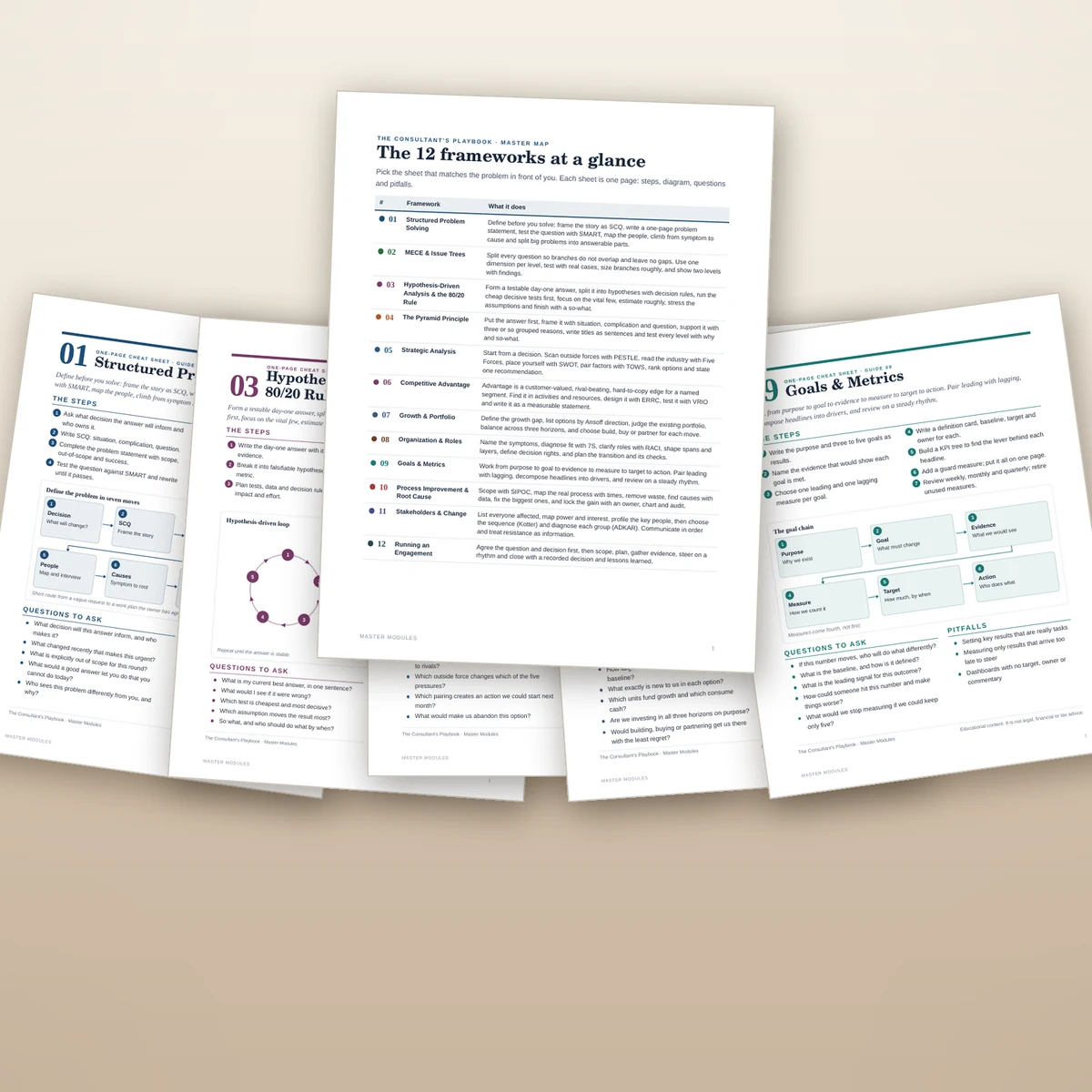
Guide 8 of The Consultant's Playbook covers what organization design is for, the 7S model, RACI, spans and layers, the operating model canvas and decision rights. It includes a fictional field-services case and a RACI and Decision Rights worksheet, along with a 7S diagnosis canvas.
Educational content. It is not legal, financial or tax advice.