Kotter's 8-Step Change Model: A Practical Guide
Kotter's eight-step model describes the sequence that large organizational changes usually need: create urgency, build a coalition, form a vision, communicate it, remove obstacles, win early, keep going and make it stick. John Kotter, a Harvard professor, published it in 1996 after studying dozens of organizations attempting transformation. He noticed that failures tended to skip the same steps.
The model is not a law of nature. Its value is as a diagnostic: when a change is struggling, you can usually find the step that was rushed or missed.
The eight steps in three phases
| Phase | Steps | Purpose |
|---|---|---|
| Create the climate for change | 1. Create urgency, 2. Build a guiding coalition, 3. Form a vision and strategy | Get people ready |
| Engage and enable the organization | 4. Communicate the vision, 5. Remove obstacles, 6. Generate short-term wins | Get people moving |
| Implement and sustain | 7. Sustain acceleration, 8. Institute the change | Make it permanent |
Phase one: create the climate
Step 1: Create urgency
People rarely change while they feel comfortable. Urgency is not panic. It is a shared sense that staying put carries a cost. Build it from evidence people can see: a metric moving the wrong way, a customer complaint pattern, a competitor's move, a regulation with a date. Let people experience the problem directly where possible.
Step 2: Build a guiding coalition
A change needs a team with enough power, credibility, expertise and leadership to steer it. A good test: would a skeptical employee know and respect at least three of these people? Include informal leaders from the front line as well as senior sponsors. A coalition made only of executives tends to underestimate daily realities.
Step 3: Form a vision and strategy
A vision is a picture of the future that is easy to explain, appealing and feasible. If you cannot say it in a few sentences in under a minute, it is not ready. Pair it with a strategy, the main moves that will get you there. A vision without a strategy is a slogan. A strategy without a vision is a list of projects.
Phase two: engage and enable
Step 4: Communicate the vision
Plan for far more communication than feels natural. People hear a message several times before they absorb it. Use simple language, repeat the same core story across channels and, most importantly, make behavior consistent with it. Leaders who say the change matters but keep old habits send a louder message than any newsletter.
Step 5: Remove obstacles
Look for four kinds of barrier: structures that conflict with the new way (an approval chain, a job description), systems that make it hard (tools, data), skills that are missing, and people, often managers, who block. Clear them, and deal openly with the person who undermines the change when persuasion has failed.
Step 6: Generate short-term wins
Large changes take long enough that energy fades. Plan visible improvements early, ideally within a few months, that are unambiguous and clearly tied to the change. A win is evidence that the effort works and a reason for fence-sitters to join. Recognize the people who made it happen.
Phase three: implement and sustain
Step 7: Sustain acceleration
The most common mistake is declaring victory too soon. After an early win, use the credibility to tackle the harder parts: systems and policies that do not yet fit, remaining departments, more ambitious targets. Keep urgency alive.
Step 8: Institute the change
A change is done when it is simply how work is done. Connect new behaviors to the organization's success, build them into onboarding, performance measures, promotion criteria and routine meetings, and make sure the next generation of leaders embodies them. If incentives still reward the old behavior, the old behavior will return.
Use the model as a diagnostic
| What you observe | Likely missing step | First remedy |
|---|---|---|
| People nod in meetings and change nothing | 1. Urgency | Show the problem with real data or direct experience |
| The sponsor is alone; middle managers drift | 2. Coalition | Recruit respected peers into the guiding team |
| Everyone describes the change differently | 3 or 4. Vision, communication | Write a one-paragraph vision and test it with ten people |
| Good intentions, constant exceptions | 5. Barriers | List and remove the three biggest structural obstacles |
| Fatigue after six months | 6. Short-term wins | Plan and publicize a visible improvement |
| Backsliding after the project ends | 7 or 8. Build on it, anchor | Update measures, onboarding and incentives |
A fictional example
A regional logistics company wants supervisors to log yard delays in an app. The sponsor starts with step 4 (a launch email) and skips the earlier steps. Usage stays low. Mapped to the model: urgency is weak (supervisors do not see why it matters), there is no coalition on the night shift, and the tablets are slow (an obstacle). The team goes back, shares the cost of morning dispute calls (step 1), enlists two respected supervisors (step 2), fixes the connectivity (step 5), and publicizes the first depot that cut disputes (step 6). Adoption improves.
Limits of the model
- It suggests a tidy order, but real changes overlap and loop.
- It leans top-down. It works best for organization-wide or department-wide programs.
- It describes the organization, not the individual. For personal adoption, pair it with the ADKAR model.
- It says little about how to handle active opposition. See resistance to change.
Practical checklist
- Is there a number or story that makes the cost of standing still visible?
- Who is on the guiding team, and would a skeptic respect them?
- Can the vision be said in under a minute?
- How many times and in how many channels will it be communicated?
- What are the three biggest obstacles, and who removes each?
- What visible win will happen within a few months?
- What will make the change permanent: procedures, onboarding, measures, incentives?
Make these part of your project charter and review progress at each steering committee meeting.
Go deeper
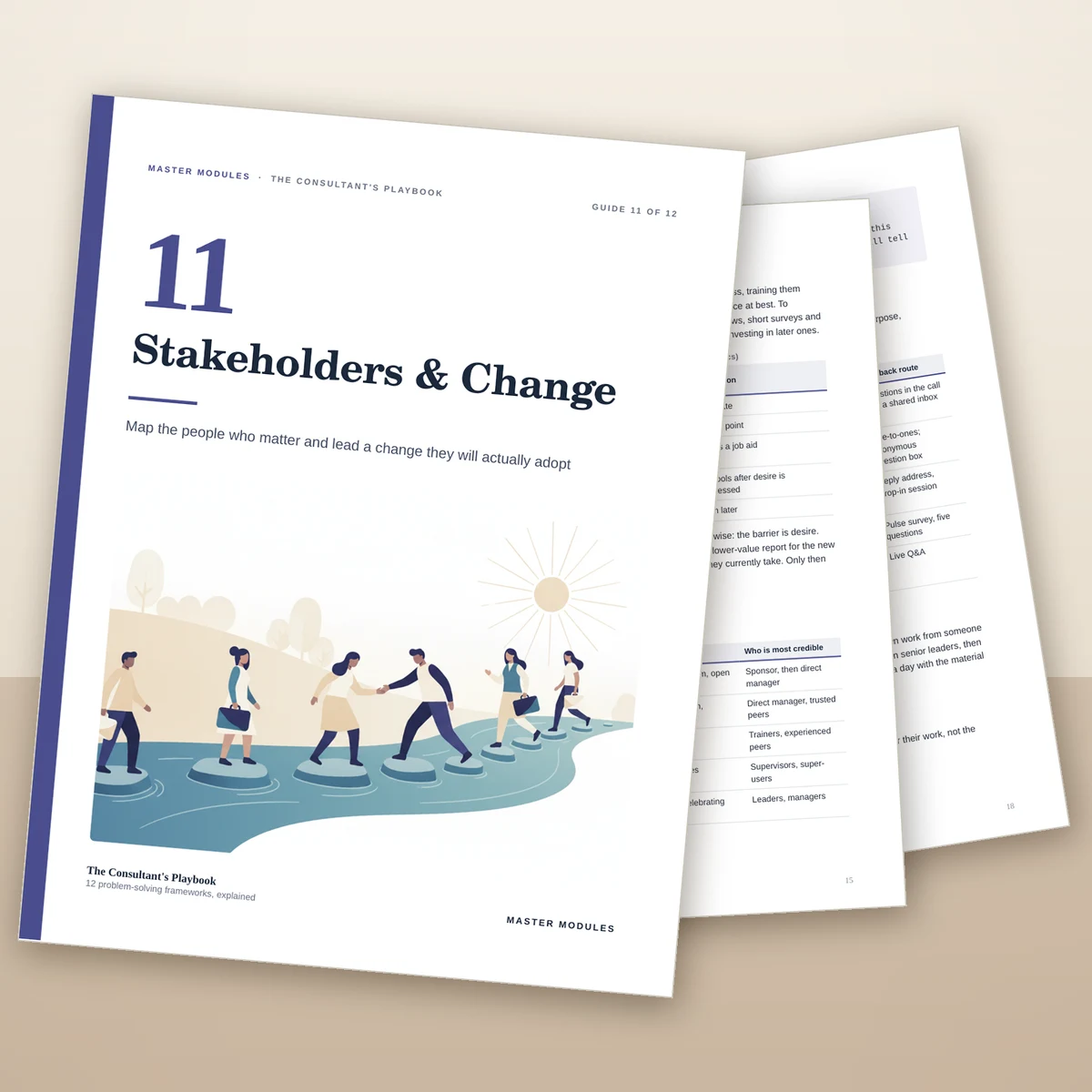
Guide 11 of The Consultant's Playbook covers the people side of projects: why change stalls, stakeholder identification and the power/interest map, understanding each stakeholder's needs, Kotter's eight steps, ADKAR, a communication plan and how to work with resistance. It includes a fictional logistics case and a Stakeholder Register and Power/Interest Grid worksheet.
Educational content. It is not legal, financial or tax advice.